

Rule the AEO/GEO Era: The Ultimate Guide to Search Visibility in 2026
March 27, 2026 | Blog
Introduction: The New Rules of Visibility
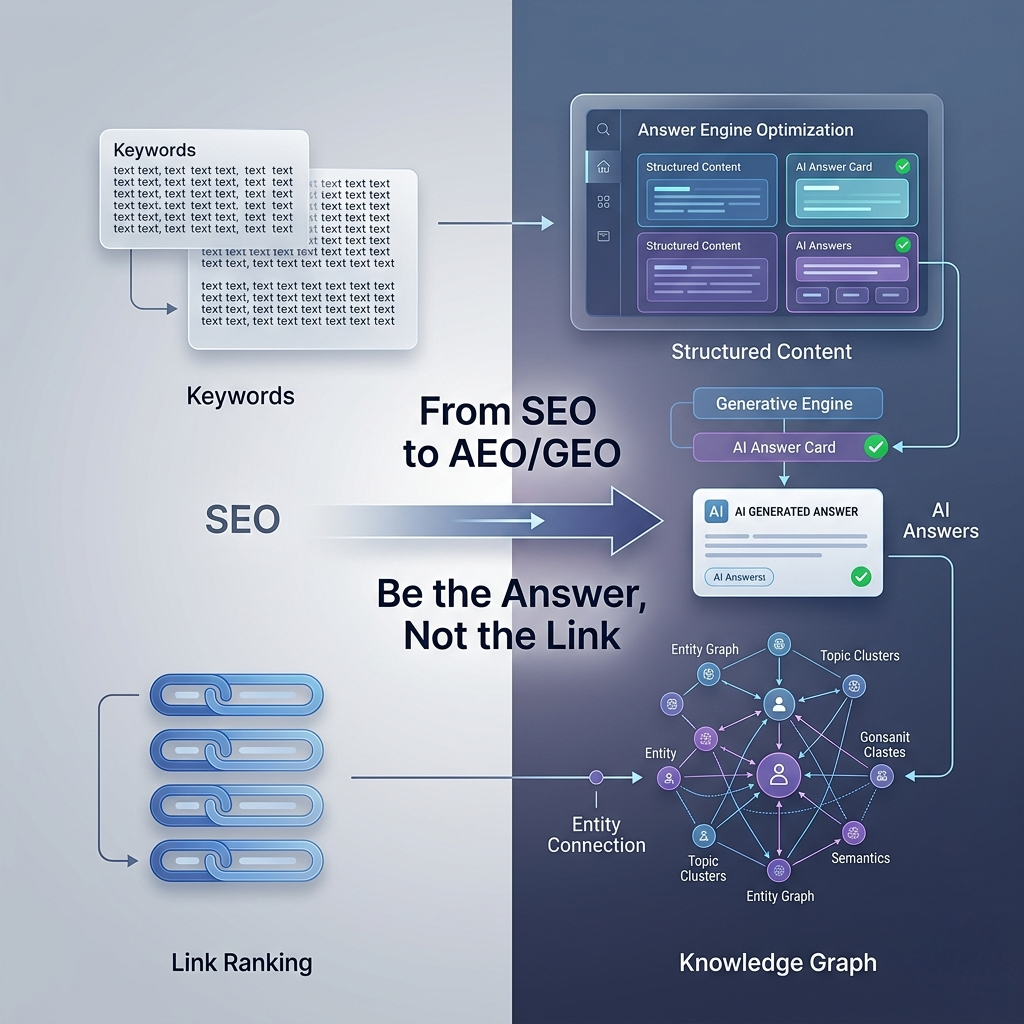
Search is no longer about rankings. It’s about being the answer.
By 2026, platforms like ChatGPT, Google Gemini, and Perplexity AI have fundamentally reshaped how users discover information. Instead of browsing 10 links, users now consume one synthesized response.
This shift demands a new playbook-one where brands are not optimized for clicks, but for citations inside AI-generated answers.
This is where Answer Engine Optimization (AEO) and Generative Engine Optimization (GEO) take over.
-
The 2026 Shift: Why Traditional SEO Died
Direct Answer
Traditional SEO hasn’t disappeared-but it’s no longer the primary driver of visibility. In 2026, over 60% of B2B queries are resolved within AI-generated summaries, eliminating the need to click through search results. Brands must now optimize for AI comprehension, authority, and structured knowledge, not just rankings.
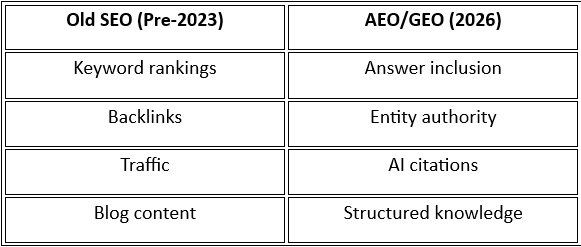
From “Ranking on Google” to “Being the Answer”
According to McKinsey & Company, AI-assisted decision-making in B2B buying journeys has increased by over 45% since 2024. Meanwhile, HubSpot reports that users now trust AI summaries nearly as much as organic search results.
What Changed Fundamentally
AEO vs GEO Explained
AEO (Answer Engine Optimization)
- Focus: Featured snippets, direct answers
- Goal: Be the top extracted answer
- Format: Concise, structured, authoritative
GEO (Generative Engine Optimization)
- Focus: AI models like ChatGPT and Gemini
- Goal: Be referenced in generated outputs
- Format: Deep, entity-rich, contextually layered
According to Boston Consulting Group, brands that adapt to AI-driven discovery see 30–50% higher conversion efficiency due to reduced friction in decision-making.
The New Success Metric: AI Citability
In 2026, the real question is not:
“Are you ranking?”
But:
“Are you being cited?”
-
The Software Agency Blueprint: SEO for B2B Tech
Direct Answer
A successful SEO strategy for software agencies in 2026 focuses on problem-solution authority, structured content clusters, and AI-readable expertise. Instead of targeting keywords alone, agencies must build domain-level trust signals that AI models recognize and prioritize.
Why Software Agencies Need a Different Approach
B2B buyers don’t search like consumers. They ask:
- “Best CRM for mid-market SaaS”
- “How to scale lead generation for enterprise SaaS”
These are multi-layered queries, which AI engines answer using trusted sources-not just optimized pages.
The 2026 SEO Framework for Software Agencies
- Problem-Led Content Clusters
Instead of generic blogs, build clusters like:
- SaaS Lead Generation
- Enterprise CRM Optimization
- Product-Led Growth
Each cluster should include:
- Thought leadership
- Case studies
- Data-backed insights
- Case-Study Driven Authority
A strong SEO strategy for software agencies now looks like:
Example Structure:
- Challenge: Low inbound leads
- Strategy: AEO-focused content + paid amplification
- Result: 3x qualified pipeline
According to Bain & Company, case-study-led marketing improves conversion rates by up to 80% in B2B environments.
- Entity & Topical Authority
AI engines prioritize:
- Recognized brands
- Consistent narratives
- Cross-platform mentions
This means your brand must exist across:
- Website
- Industry publications
- Podcasts
- Structured Content for AI Parsing
Use:
- Clear headings (H1–H4)
- Bullet points
- Direct answer blocks
- Schema markup
According to Zoho Corporation, structured content improves machine readability by over 35%, directly impacting AI visibility.
The Bottom Line
SEO is no longer about optimizing pages.
It’s about training AI models to trust your brand.

-
The Rise of the Fractional CMO
Direct Answer
Fractional CMO Services have become the preferred growth model for mid-market companies in 2026 because they provide senior strategic leadership without the cost or rigidity of full-time hires, enabling faster adaptation to AI-driven marketing shifts.
Why the Shift Happened
Hiring a full-time CMO today comes with:
- High fixed cost
- Long onboarding cycles
- Limited agility
Meanwhile, AI-driven marketing requires:
- Constant experimentation
- Cross-channel integration
- Rapid decision-making
The Fractional CMO Advantage
- Strategic Depth Without Overhead
Access leadership with:
- 10–15+ years experience
- Multi-industry exposure
- Proven frameworks
- AI-Native Marketing Leadership
A modern Fractional CMO focuses on:
- AEO/GEO strategy
- Performance marketing integration
- Data-driven experimentation
According to EY, companies adopting agile leadership models see 25–40% faster go-to-market execution.
- Full-Funnel Alignment
From awareness to conversion:
- SEO + Paid + Social work together
- Messaging remains consistent
- Data flows seamlessly
Why It Matters for 2026
In a world where AI determines visibility,
Strategy is no longer optional, it’s the differentiator.
-
Hyper-Local Dominance: Gurgaon as a Growth Engine
Direct Answer
An AI Marketing Solutions Agency in Gurgaon gains a competitive edge by combining hyper-local market intelligence with global AI-driven frameworks, enabling businesses to dominate both regional and global search ecosystems.
Gurgaon: India’s B2B Growth Hub
Gurgaon has evolved into:
- A SaaS and startup hotspot
- A corporate headquarters cluster
- A high-intent B2B market
This makes it a perfect testing ground for AI-driven marketing strategies.
How The Violet Builds Local + Global Authority
- Localized Search Intelligence
- Targeting NCR-specific queries
- Understanding regional buyer behavior
- Leveraging local business signals
- AI-First Campaign Architecture
As an AI Marketing Solutions Agency in Gurgaon, The Violet integrates:
- SEO (AEO + GEO)
- Google Ads (intent capture)
- Social media (brand amplification)
- Data + Creative + Performance
This combination ensures:
- Visibility in AI answers
- High-quality lead generation
- Strong brand recall
The Competitive Advantage
Most agencies still optimize for Google.
The Violet optimizes for:
AI ecosystems + local dominance
-
The 2026 Checklist: Become AI-Citable
Direct Answer
To become AI-citable in 2026, brands must focus on structured authority, entity consistency, data-backed content, and multi-channel presence, ensuring AI systems can easily recognize, trust, and reference their expertise.
The 5-Step Framework
- Build Answer-First Content
- Start with direct responses
- Keep answers concise (40–60 words)
- Use structured formatting
- Establish Entity Authority
- Consistent brand mentions
- Strong LinkedIn presence
- Industry citations
- Create Deep Topical Clusters
- Own specific niches
- Publish consistently
- Interlink content intelligently
- Integrate Performance Marketing
- Use paid ads to amplify content
- Capture high-intent users
- Retarget effectively
- Leverage Data & Proof
Include:
- Case studies
- Industry stats
- Real outcomes
According to McKinsey & Company, data-backed narratives improve trust by over 60% in enterprise decision-making.
Conclusion: The Brands That Win in 2026
The shift is clear:
- SEO is no longer about search engines
- It’s about answer engines and AI ecosystems
The brands that will dominate are those that:
✔ Think in entities, not keywords
✔ Build authority, not just traffic
✔ Optimize for AI, not just Google
Your Next Move
If your brand is still operating on a 2020 SEO playbook, you’re already behind.
The opportunity? Massive.
The window? Closing fast.
Book Your Free 2026 Digital Growth Audit
Partner with The Violet your AI-first growth partner in Gurgaon and transform your visibility strategy for the AEO/GEO era.
Get a customized roadmap across:
- SEO (AEO + GEO)
- Paid campaigns
- Social media
- Fractional CMO strategy
Because in 2026, visibility isn’t earned.
It’s engineered.
FAQs: AEO & GEO Optimization (2026)
- What is the difference between AEO and GEO?
AEO (Answer Engine Optimization) focuses on structuring content to directly answer user queries (like featured snippets), while GEO (Generative Engine Optimization) ensures your brand is referenced in AI-generated responses from platforms like ChatGPT and Google Gemini. AEO is about extraction; GEO is about inclusion.
- How do I make my content AI-citable?
To become AI-citable, your content must be:
- Structured (clear headings, bullet points)
- Authoritative (data-backed, expert-led)
- Entity-rich (consistent brand mentions across platforms)
- Contextual (answers layered with depth, not just surface-level info)
- Is traditional SEO still relevant in 2026?
Yes, but as a foundation. Traditional SEO helps with discoverability, but AEO and GEO determine whether your content is surfaced inside AI-generated answers, which is where most user attention now lies.
- What type of content works best for AEO/GEO?
The most effective formats include:
- Answer-first blogs
- Case studies (especially for B2B)
- Industry insights with credible data
- Structured guides and frameworks
This is especially critical for building a strong SEO strategy for software agencies, where trust and depth matter more than volume.
- How important is authority for GEO?
Extremely important. AI models prioritize sources that demonstrate:
- Consistent expertise
- Cross-platform presence
- Credible mentions (e.g., reports from McKinsey & Company or HubSpot)
Without authority, even well-written content may not be referenced.
- Can small or mid-sized businesses compete in AEO/GEO?
Absolutely. With the right strategy—often led by Fractional CMO Services—mid-sized businesses can outperform larger brands by being:
- More agile
- More niche-focused
- Faster at adopting AI-first content frameworks
- How long does it take to see results from AEO/GEO?
Unlike traditional SEO, AEO/GEO can show early traction within 6–12 weeks, especially if supported by:
- High-quality content clusters
- Paid amplification
- Strong internal linking and schema
However, long-term authority building remains key for sustained visibility.
- Why is local context important for AI optimization?
AI models increasingly factor in location relevance. For example, positioning yourself as an AI Marketing Solutions Agency in Gurgaon helps you dominate both:
- Local high-intent queries
- Broader industry conversations
This creates a powerful dual advantage in AI-driven discovery.