

What Does a Fractional CMO Do in the First 90 Days? A Practical Roadmap for Growing Businesses
August 22, 2026 | Blog, Fractional CMO
Key Takeaways
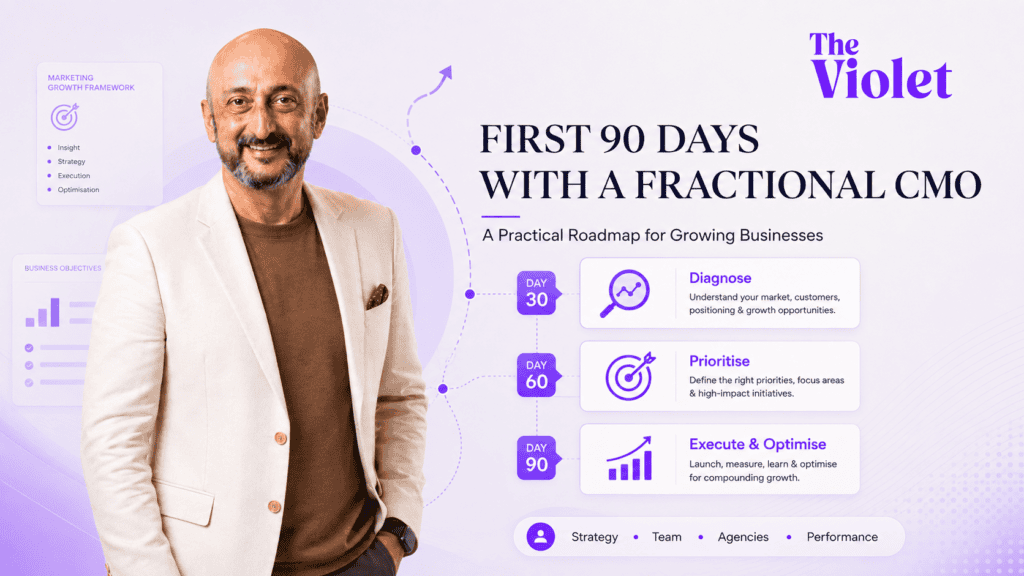
- The first 90 days should follow a structured roadmap divided into three phases: Diagnose (Days 1–30), Prioritise (Days 31–60), and Execute & Optimise (Days 61–90).
- A Fractional CMO provides senior marketing leadership, taking ownership of strategy, positioning, budgets, teams, agencies, KPIs, and marketing performance.
- The first month focuses on diagnosis, including business goals, customer research, positioning, marketing audits, performance reviews, and agency assessments.
- By Day 30, leadership should have clarity on marketing challenges, customer segments, funnel gaps, channel performance, and immediate priorities.
- Days 31–60 are about prioritisation, defining marketing priorities, KPIs, budgets, responsibilities, and creating a practical execution roadmap.
- A strong Fractional CMO focuses on what matters most, avoiding the mistake of trying to execute every marketing channel at once.
- The final 30 days focus on execution and optimisation, improving campaigns, fixing funnel bottlenecks, strengthening sales-marketing alignment, and eliminating ineffective activities.
- Success after 90 days is measured by clarity, accountability, measurement, and decision-making, not by the number of campaigns launched.
- A Fractional CMO should align agencies, internal teams, and leadership, creating a repeatable operating rhythm that reduces founder dependency.
- The ultimate goal is to move the business from activity to direction and from marketing reports to management insights.
Hiring a Fractional CMO should not result in three months of presentations, workshops and marketing jargon.
Within the first 90 days, a growing business should have much more clarity around:
- Who it is trying to reach
- What it should communicate
- Which marketing activities deserve investment
- Which activities should stop
- Who owns each marketing priority
- How agencies and internal teams should work together
- Which numbers management should review
- What needs to happen next
That is the difference between hiring another marketing consultant and bringing in genuine marketing leadership.
A Fractional CMO works as a senior marketing leader without requiring the business to immediately hire a full-time Chief Marketing Officer.
But what should they actually do once they join?
Here is a practical 90-day roadmap.
What Does a Fractional CMO Actually Do?
A Fractional CMO takes senior ownership of the marketing function.
Depending on the business, this can include:
- Marketing strategy
- Customer and ICP definition
- Positioning
- Go-to-market planning
- Marketing budgets
- Agency management
- Internal team leadership
- Performance reviews
- Sales and marketing alignment
- Funnel improvement
- Marketing technology
- Management reporting
The role is different from that of a marketing agency.
An agency may execute SEO, advertising, social media, design or content.
A Fractional CMO should determine what needs to be executed, why it matters, who should execute it and how success will be measured.
If you are deciding between the two models, read our detailed comparison of a Fractional CMO vs Marketing Agency.
The First 90 Days Should Have Three Clear Phases
A useful way to structure a Fractional CMO engagement is:
Days 1 to 30: Diagnose
Days 31 to 60: Prioritise
Days 61 to 90: Execute and Optimise
The objective is not to change everything immediately.
It is to understand the business well enough to make better marketing decisions quickly.
Days 1 to 30: Diagnose Before You Prescribe
The first month should primarily be about understanding what is actually happening.
This sounds obvious.
Yet many businesses make the mistake of hiring a new marketing leader and immediately asking:
“What campaigns should we launch?”
That may be the wrong starting question.
Before recommending another campaign, the Fractional CMO should understand the complete marketing and sales system.
- Understand the Business Goals
Marketing strategy should begin with business strategy.
The Fractional CMO should understand:
- Revenue objectives
- Growth priorities
- Key products or services
- Most profitable customer segments
- Geographic priorities
- New markets
- Sales cycle
- Average deal value
- Business constraints
A company trying to increase recurring B2B revenue needs a very different marketing strategy from one launching a new D2C product.
- Review the Customer
A surprising amount of marketing waste starts with an unclear definition of the customer.
The Fractional CMO should examine:
- Who currently buys
- Who the business wants to attract
- Who is most profitable
- Why customers choose the company
- Why prospects reject it
- What questions buyers ask before purchasing
- What objections sales encounters
This should eventually lead to much clearer customer segments and ICPs.
- Review Positioning and Messaging
The next question is:
If the right customer reaches us, do they immediately understand why they should choose us?
Review:
- Website hero
- Service pages
- Sales presentations
- Ads
- LinkedIn presence
- Email communication
- Proposals
- Competitor positioning
A marketing problem is sometimes actually a positioning problem.
Increasing ad spend will not solve unclear messaging.
- Audit the Current Marketing Activity
The Fractional CMO should build a complete map of what marketing is currently doing.
For example:
Paid Media
Google Ads
Meta Ads
LinkedIn Ads
Organic
SEO
AEO/GEO
Content
Social media
Conversion
Website
Landing pages
Forms
CRM
Retention
Email
WhatsApp
Customer communication
Brand
PR
Founder branding
Events
Partnerships
Then ask a simple question about each:
Why are we doing this?
If nobody can clearly answer, that activity deserves examination.
- Review the Numbers
A Fractional CMO should not accept a marketing report simply because it contains charts.
Look beyond:
- Reach
- Impressions
- Followers
- Traffic
- Clicks
towards:
- Cost per lead
- Qualified lead rate
- Conversion rate
- Customer acquisition cost
- Pipeline generated
- Sales conversion
- Channel contribution
- Revenue attribution where possible
For B2B businesses, one of the most important conversations is often between marketing and sales.
Marketing may say:
“We generated 300 leads.”
Sales may say:
“Only 20 were relevant.”
That gap needs to be investigated.
- Audit Agencies and Vendors
Many growing businesses already have multiple specialists.
Perhaps:
- Google Ads agency
- SEO agency
- Designer
- Website developer
- Social media team
- PR consultant
The Fractional CMO should not immediately replace them.
First determine:
Are their briefs clear?
Are they working towards the same business priorities?
Are KPIs meaningful?
Is there duplication?
Are they producing activity or outcomes?
A strong Fractional CMO can often improve agency performance simply by improving leadership and direction.
This is especially relevant if your marketing feels busy but lacks coordination. Our article on how a Fractional CMO bridges the marketing strategy gap explores this problem further.
What Should Exist by Day 30?
By the end of the first month, management should ideally have:
- Clearer marketing challenges
- Customer and ICP observations
- Funnel gaps
- Channel performance assessment
- Agency assessment
- Measurement gaps
- Immediate priorities
- Activities that may need to stop
The most valuable output is not a 100-slide presentation.
It is clarity.
Days 31 to 60: Prioritise What Matters
Once the business has been diagnosed, the Fractional CMO should move from:
“Here is what we found”
to:
“Here is what we are going to do about it.”
This is where leadership becomes visible.
- Create the Marketing Priorities
Most businesses do not have an idea shortage.
They have a prioritisation problem.
There may be twenty things the business could do.
The Fractional CMO should identify the three to five things that matter most.
For example:
Priority 1
Fix the website conversion journey.
Priority 2
Improve Google Ads lead quality.
Priority 3
Build founder-led LinkedIn demand.
Priority 4
Strengthen SEO around high-intent service searches.
Not:
SEO + Meta + Google + LinkedIn + YouTube + podcasts + PR + influencers + email + webinars all at once.
Marketing leadership means deciding what not to prioritise.
- Build a 90-Day Marketing Roadmap
The roadmap should clearly identify:
| Priority | Action | Owner | KPI | Timeline |
| Lead quality | Refine targeting and landing page | Agency + internal team | Qualified lead % | 30 days |
| Website | Improve primary service pages | Web/content | Conversion rate | 45 days |
| SEO | Strengthen commercial topic clusters | SEO team | Qualified organic traffic | 90 days |
| Reporting | Build CEO dashboard | Marketing lead | Monthly decision metrics | 30 days |
Everyone should know:
What are we doing?
Who owns it?
When is it due?
How will we judge it?
- Allocate Marketing Budget
Budget allocation should follow strategy.
Not history.
A Fractional CMO should ask:
If we had to rebuild this marketing budget today, would we allocate it the same way?
If the answer is no, change it.
That may mean:
- Increasing one channel
- Reducing another
- Moving money from media to conversion
- Investing in content
- Improving CRM
- Hiring missing capability
Sometimes the biggest performance improvement comes from moving budget rather than increasing budget.
- Define the KPIs Management Should See
A CEO should not receive a 27-page marketing report every month.
The leadership dashboard should answer a few critical questions.
What did we spend?
What did we generate?
What converted?
Where are we losing prospects?
What improved?
What deteriorated?
Why?
What are we changing next?
Marketing reports should support decisions, not merely document activity.
- Clarify Team and Agency Responsibilities
By this stage, responsibility should become extremely clear.
For example:
Fractional CMO
Strategy and accountability
Performance Agency
Campaign execution
SEO Team
Organic visibility
Designer
Creative execution
Marketing Manager
Coordination and implementation
Sales Team
Lead feedback and conversion
The Fractional CMO should remove the confusion where:
everyone is involved but nobody is accountable.
What Should Exist by Day 60?
By the end of the second month, the business should ideally have:
- Clear marketing priorities
- Updated strategy
- Budget allocation
- Defined KPIs
- 90-day roadmap
- Team responsibilities
- Agency expectations
- Reporting structure
Now the organisation moves from diagnosis to controlled execution.
Days 61 to 90: Execute, Measure and Optimise
By the third month, strategy should start becoming visible in the work.
The Fractional CMO’s role is not necessarily to execute every activity personally.
The role is to ensure execution happens correctly.
- Improve Campaign Decision-Making
Suppose Google Ads CPL has increased from ₹2,000 to ₹3,000.
The response should not automatically be:
“Reduce the CPL.”
Instead investigate:
- Has CPC increased?
- Has competition changed?
- Has conversion rate dropped?
- Has lead quality improved?
- Is the landing page weaker?
- Has the audience saturated?
- Has the offer become less competitive?
- Is sales response time affecting conversion?
Marketing performance is rarely explained by one number.
- Improve the Funnel
Campaign optimisation alone is often insufficient.
The Fractional CMO should examine the journey:
Ad → Landing Page → Form → CRM → Sales Call → Proposal → Customer
If advertising performs well but the landing page converts poorly, improve the page.
If leads are good but sales takes two days to respond, fix the response process.
If prospects repeatedly reject the pricing, review positioning.
This is why senior marketing leadership needs visibility beyond the advertising dashboard.
- Create a Sales-Marketing Feedback Loop
One of the most useful recurring meetings can be surprisingly simple.
Marketing asks sales:
Which leads were good?
Which were poor?
Why?
Which objections are appearing?
Which customer segments convert?
What questions are prospects asking?
Those insights should flow back into:
- Ads
- Content
- Landing pages
- SEO
- Sales collateral
- Positioning
That is how marketing starts learning from revenue rather than operating separately from it.
- Stop What Is Not Working
By month three, there should be enough information to make harder decisions.
Perhaps:
- One channel should be stopped
- One agency needs a stronger brief
- One campaign should be scaled
- One target segment should be deprioritised
- One website page needs rebuilding
- One reporting metric is meaningless
A Fractional CMO earns trust not by constantly proposing more marketing activity, but by being willing to say:
We should stop spending money here.
- Establish the Operating Rhythm
By Day 90, marketing should begin operating through a predictable rhythm.
For example:
Weekly
Execution review
Fortnightly
Campaign and pipeline review
Monthly
Leadership marketing review
Quarterly
Strategy and budget review
The organisation should no longer depend on random WhatsApp messages and urgent requests to decide its marketing priorities.
What Should Exist by Day 90?
A strong 90-day Fractional CMO engagement should leave the business with:
Strategic Clarity
Who are we targeting?
What are we positioning?
Where are we investing?
Commercial Measurement
Which activities influence leads, pipeline and revenue?
Clear Ownership
Who is responsible for what?
Better Marketing Decisions
What should we scale, improve or stop?
Management Visibility
What does leadership need to know each month?
Operating Rhythm
How does marketing run without constant founder intervention?
That is much more meaningful than simply producing more campaigns.
What a Fractional CMO Should NOT Spend 90 Days Doing
There are also warning signs.
Be cautious if the first three months consist mainly of:
Endless workshops
Understanding the business matters, but eventually decisions must be made.
Creating strategies nobody owns
A strategy without execution accountability is a presentation.
Replacing agencies immediately
Existing partners should be evaluated before being replaced.
Launching every channel
More marketing activity is not automatically better marketing.
Reporting vanity metrics
Followers and impressions rarely answer the CEO’s real questions.
Acting like another agency account manager
The Fractional CMO should operate at the level of priorities, budgets, people and outcomes.
How Should a CEO Judge a Fractional CMO After 90 Days?
Don’t ask only:
“How many leads did they generate?”
That may depend on the sales cycle and starting position.
Instead assess whether these things improved:
- Marketing clarity
Do we know what we are trying to achieve?
- Priority
Does the team know what matters most?
- Accountability
Does every important activity have an owner?
- Measurement
Can leadership see what is working?
- Lead quality
Are marketing and sales measuring the same outcome?
- Agency effectiveness
Are vendors receiving better direction?
- Decision speed
Are marketing decisions happening faster?
- Founder dependence
Does the founder still have to manage every marketing issue?
- Marketing efficiency
Are we spending differently based on evidence?
- Forward plan
Does everyone know what the next quarter requires?
If those things are materially clearer after 90 days, the marketing function is becoming stronger.
When Does a Fractional CMO Make the Most Sense?
The model is particularly useful when a company:
- Already spends meaningfully on marketing
- Has agencies but lacks senior ownership
- Has an internal marketing team without a senior leader
- Is entering a new growth stage
- Needs better sales and marketing alignment
- Wants to professionalise marketing before hiring a full-time CMO
- Needs an experienced leader without a permanent executive commitment
For smaller organisations, you may also find our guide on Fractional CMO services for small teams useful.
Do You Need a Fractional CMO or Just Better Execution?
This is an important distinction.
You probably need better execution if:
Your strategy is clear, but campaigns or content are not being executed effectively.
You may need a Fractional CMO if:
Your team is executing, but nobody can clearly answer:
What should we prioritise?
Why are we doing it?
How much should we spend?
Who is accountable?
What should we stop?
A Fractional CMO should solve a leadership problem, not simply become another marketing resource.
The Bottom Line
The first 90 days of a Fractional CMO engagement should not be judged by the number of marketing activities launched.
They should be judged by whether the business has moved from:
activity → direction
data → decisions
vendors → coordinated teams
marketing reports → management insight
founder dependence → marketing ownership
By Day 90, the business should understand what marketing needs to achieve, how it will achieve it, who owns each priority and how leadership will know whether it is working.
That is the role of a Fractional CMO.
If your company has reached the stage where marketing is becoming too important to operate without senior ownership, explore The Violet’s Fractional CMO Services in India.
And if you are still deciding whether your business needs senior leadership or an execution partner, read Fractional CMO vs Marketing Agency: Which One Does Your Business Actually Need?.
Frequently Asked Questions
What does a Fractional CMO do?
A Fractional CMO provides senior marketing leadership on a part-time or retained basis. They can take responsibility for marketing strategy, positioning, budgets, teams, agencies, measurement, sales alignment and performance without joining as a full-time executive.
What should a Fractional CMO do in the first 30 days?
The first 30 days should focus primarily on diagnosis. This usually includes understanding the business goals, customers, positioning, existing campaigns, agencies, marketing team, sales funnel, budgets and current performance.
What should happen in the first 60 days?
By approximately Day 60, the Fractional CMO should have translated the initial diagnosis into priorities, KPIs, budget decisions, team responsibilities and a practical marketing roadmap.
What should a Fractional CMO deliver after 90 days?
By Day 90, a business should have clearer marketing priorities, improved accountability, a defined operating rhythm, stronger performance measurement and a forward plan for the next quarter.
Does a Fractional CMO execute campaigns?
Usually, the Fractional CMO leads and oversees execution rather than personally executing every marketing activity. Internal teams, agencies or specialists may handle campaign execution while the Fractional CMO provides strategy, direction and accountability.
Can a Fractional CMO manage existing marketing agencies?
Yes. Agency management is often an important part of the role. The Fractional CMO can establish priorities, improve briefs, define KPIs, review performance and coordinate multiple agencies around the same business objectives.
How quickly should a Fractional CMO produce results?
The timeline depends on the business, sales cycle and problems being solved. Some improvements in clarity, priorities and marketing operations can happen quickly, while commercial outcomes such as pipeline and revenue may require longer measurement periods.
How do I know if my Fractional CMO is performing well?
Look beyond campaign activity. Evaluate whether marketing priorities are clearer, teams and agencies are better aligned, management reporting has improved, budgets are being allocated more intelligently and marketing is becoming less dependent on the founder.
Is a Fractional CMO only useful for large businesses?
No. Growing SMEs, B2B companies, SaaS businesses and founder-led organisations can benefit when their marketing complexity has grown beyond what the founder or junior marketing team can effectively lead.
What happens after the first 90 days?
The next phase usually focuses on scaling what works, fixing remaining funnel gaps, improving team capability, refining budgets and building the next quarterly marketing plan based on evidence from the first 90 days.