

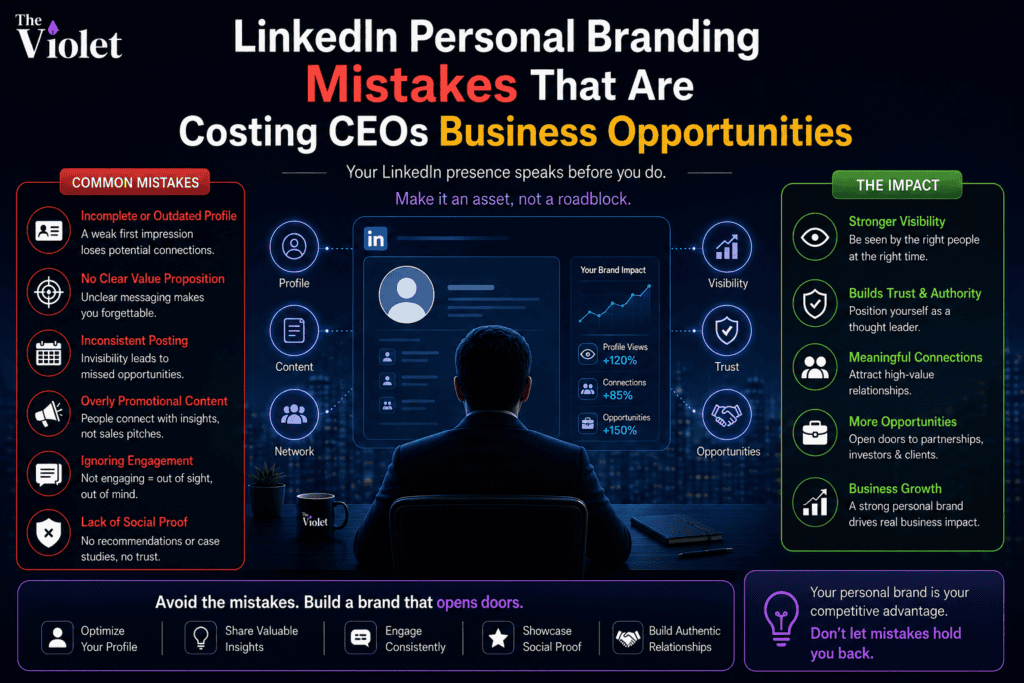
LinkedIn Personal Branding Mistakes That Are Costing CEOs Business Opportunities
July 19, 2026 | Blog
Key Takeaways
- LinkedIn Personal Branding has become a critical component of modern business development and executive visibility.
- Buyers increasingly research founders and executives before engaging with a company.
- An inactive or poorly positioned LinkedIn presence can negatively impact trust and credibility.
- Strong Founder Branding focuses on expertise, thought leadership, and value creation rather than self-promotion.
- Consistency is more important than occasional viral posts.
- Effective LinkedIn Content Strategy supports lead generation, recruitment, partnerships, and brand authority.
- Executive visibility often generates opportunities long before traditional marketing channels do.
- Businesses that embrace Executive Branding and thought leadership gain a competitive advantage in crowded markets.
Introduction
For many CEOs, founders, and business leaders, LinkedIn is often viewed as a professional networking platform—a place to showcase career achievements, company updates, and occasional industry insights.
However, the role of LinkedIn has evolved significantly.
Today, before scheduling a meeting, responding to a sales proposal, considering a partnership, or even applying for a role, people are researching the individuals behind the business. They want to understand who they are engaging with, what expertise they bring, and whether they can be trusted.
This shift has transformed LinkedIn Personal Branding from an optional activity into a critical business growth strategy.
The reality is simple: buyers trust people before they trust brands.
A well-positioned executive presence can create opportunities, strengthen credibility, accelerate trust, and influence purchasing decisions long before the first sales conversation begins. Yet many business leaders fail to leverage LinkedIn effectively.
Some remain inactive. Others focus entirely on self-promotion. Many publish content without a clear strategy or understanding of how personal branding contributes to business growth.
The result is missed opportunities, reduced visibility, weaker authority, and slower growth.
Fortunately, most personal branding challenges are not caused by a lack of expertise. They stem from common mistakes that can be corrected with the right approach.
In this article, we’ll explore the most common LinkedIn Personal Branding mistakes CEOs make, why these mistakes matter, and how executives can build a stronger presence that supports both personal and business growth.
Read More : Fractional CMO Services: Big Impact for Small Teams
The Rise of Founder-Led Marketing in B2B
The B2B buying process has changed dramatically over the last decade.
In the past, company websites, brochures, and sales presentations played the primary role in influencing buyer decisions.
Today, buyers conduct extensive independent research before engaging with vendors.
They review websites.
They read reviews.
They evaluate case studies.
And increasingly, they research company leadership.
This trend has contributed to the growth of Founder-Led Marketing, where the personal brand of executives becomes an important driver of trust and business growth.
People connect with people.
While company pages communicate what a business does, personal brands communicate why buyers should trust the people behind it.
This is particularly important in industries where products and services appear similar on the surface.
A visible and credible founder often becomes a company’s strongest differentiator.
How LinkedIn Influences Modern Buying Decisions
Today’s buyers rarely make decisions based solely on marketing materials.
Instead, they seek confidence.
They want to understand:
- Who leads the business
- What expertise they possess
- Whether they understand industry challenges
- How they think about solving problems
For many prospects, LinkedIn serves as the first touchpoint in that evaluation process.
An active profile filled with thoughtful content, industry perspectives, and valuable insights can significantly influence perception.
An outdated or inactive profile can create the opposite effect.
When executives invest in LinkedIn Thought Leadership, they create familiarity before conversations begin.
That familiarity often shortens sales cycles and strengthens trust.
Mistake #1: Treating LinkedIn Like a Digital Resume
One of the most common CEO Personal Branding mistakes is treating LinkedIn as a static profile.
Many executives optimize their profile once and rarely revisit it.
While having a strong profile matters, LinkedIn is no longer just a professional directory.
It is a content and relationship-building platform.
Your profile establishes credibility.
Your content builds authority.
Without consistent activity, even the strongest profile will struggle to generate meaningful opportunities.
Mistake #2: Focusing on the Company Instead of Personal Expertise
Many leaders use LinkedIn exclusively to share company announcements.
Product launches.
Awards.
New hires.
Company milestones.
While these updates have value, audiences connect more strongly with human experiences and expertise.
Effective Executive Branding includes sharing:
- Leadership lessons
- Industry observations
- Business challenges
- Market trends
- Customer insights
- Personal experiences
People follow individuals who provide valuable perspectives—not corporate press releases.
Mistake #3: Publishing Content Without a Strategy
Consistency without direction rarely produces meaningful results.
Many CEOs publish content sporadically without a clear understanding of their audience or objectives.
A successful LinkedIn Content Strategy begins by answering three questions:
What do you want to be known for?
Who are you trying to influence?
What business outcomes do you want to support?
Without clear positioning, content lacks focus.
With positioning, every post contributes to long-term authority building.
Mistake #4: Prioritizing Promotion Over Value
One of the fastest ways to lose audience interest is constant self-promotion.
People visit LinkedIn to learn, discover insights, and stay informed.
They are not looking for endless sales pitches.
The most effective leaders focus on creating value through:
- Industry education
- Market analysis
- Practical advice
- Leadership experiences
- Business lessons
Authority is built through contribution.
Trust follows naturally.
Read More : Personal Branding for Founders: How to Build Authority That Drives Revenue
Mistake #5: Inconsistency Is Destroying Visibility
Many executives approach LinkedIn in bursts.
They post actively for a few weeks and then disappear for months.
This inconsistency limits visibility and makes audience growth difficult.
Strong LinkedIn Personal Branding requires consistency over time.
Regular visibility creates familiarity.
Familiarity creates trust.
Trust creates opportunities.
The goal is not daily posting.
The goal is sustainable participation.
Mistake #6: Ignoring Thought Leadership
Thought leadership is often misunderstood.
It does not require being an influencer.
It requires sharing informed perspectives based on real-world experience.
Executives who consistently contribute valuable insights become recognized voices within their industry.
This creates opportunities such as:
- Speaking engagements
- Media interviews
- Strategic partnerships
- Industry recognition
- Business development opportunities
Strong Thought Leadership Marketing strengthens both personal and corporate brands.
Mistake #7: Measuring Success Through Likes Instead of Business Outcomes
Many executives judge LinkedIn success through engagement metrics.
Likes.
Comments.
Shares.
While these metrics provide useful signals, they are not the ultimate objective.
Successful Founder Branding should be evaluated through:
- Inbound inquiries
- Sales conversations
- Partnership opportunities
- Recruitment benefits
- Industry recognition
- Brand authority
Business impact matters more than vanity metrics.
Read More : Why Your Business Needs Professional Social Media Management Right Now (Before It’s Too Late)
The Hidden Cost of Ignoring Personal Branding
Many CEOs underestimate the cost of remaining invisible.
The consequences extend beyond social media.
Without a strong executive presence, businesses often experience:
- Lower trust levels
- Reduced brand differentiation
- Missed partnership opportunities
- Longer sales cycles
- Fewer speaking invitations
- Weaker recruitment outcomes
Personal branding is not about attention.
It is about influence.
And influence affects business performance.
Why Company Pages Alone Are No Longer Enough
Corporate LinkedIn pages remain valuable.
However, executive profiles often generate significantly greater engagement.
Why?
Because people engage with people.
Company pages communicate organizational updates.
Executive profiles communicate vision, expertise, and personality.
The strongest businesses combine both approaches.
Corporate branding builds awareness.
Personal branding builds trust.
Together, they create a powerful growth engine.
The Five Pillars of a Strong LinkedIn Personal Brand
Pillar 1: Positioning
Clearly define what you want to be known for.
Pillar 2: Expertise
Demonstrate knowledge through valuable insights.
Pillar 3: Visibility
Show up consistently.
Pillar 4: Authenticity
Share real experiences and perspectives.
Pillar 5: Consistency
Build authority through sustained effort.
Together, these pillars form the foundation of effective Personal Brand Building.
Creating a LinkedIn Content Strategy That Drives Business Growth
High-performing executives typically focus on a mix of content themes:
Industry Insights
Share observations and trends.
Leadership Lessons
Discuss experiences and learnings.
Customer Perspectives
Highlight challenges and solutions.
Business Growth Stories
Share lessons from scaling and transformation.
Market Commentary
Provide informed viewpoints on industry developments.
Personal Experiences
Create authenticity and connection.
A structured content approach helps maintain relevance while supporting business objectives.
What High-Performing CEOs Do Differently on LinkedIn
Average LinkedIn users often:
- Post randomly
- Focus on promotion
- Chase engagement
High-performing executives:
- Follow a strategy
- Build authority
- Share expertise
- Create trust
- Generate demand
The difference is not activity.
The difference is intentionality.
Measuring the ROI of LinkedIn Personal Branding
The return on LinkedIn Personal Branding extends beyond visibility.
Key indicators include:
- Increased inbound leads
- Higher-quality sales conversations
- Greater brand recognition
- Improved recruitment outcomes
- More speaking opportunities
- Stronger strategic partnerships
When executed effectively, personal branding becomes a long-term business asset.
How The Violet Helps CEOs Build a Strong Personal Brand
Building a successful LinkedIn Personal Branding strategy requires more than regular posting. It needs the right positioning, content strategy, and a marketing approach that connects personal visibility with business growth.
At The Violet, we help founders and business leaders build authority through:
- LinkedIn Personal Branding – creating a strong executive presence and building credibility among the target audience.
- Founder Branding Strategy – helping business owners turn their expertise and experiences into a powerful personal brand.
- LinkedIn Content Strategy – developing thought leadership content that improves visibility, engagement, and trust.
- Fractional CMO Services – creating a complete marketing roadmap that aligns branding, lead generation, and business growth goals.
- SEO & AEO Services – improving search visibility and helping brands get discovered across traditional and AI-powered search platforms.
- Performance Marketing Services – using targeted campaigns to generate qualified leads and support customer acquisition.
- Content Marketing Services – creating valuable content assets that strengthen authority and attract potential customers.
By combining personal branding, content strategy, and digital marketing expertise, The Violet helps CEOs and founders transform their online presence into a long-term business growth channel.
Read More : LinkedIn Ads for B2B Lead Generation in India: A Complete Guide
Conclusion
In today’s business environment, trust is one of the most valuable competitive advantages a leader can possess.
A strategic LinkedIn Personal Branding approach helps CEOs move beyond visibility and establish genuine authority within their industry.
By avoiding common mistakes, focusing on value creation, and maintaining consistency, business leaders can transform LinkedIn from a networking platform into a powerful business growth channel.
The opportunity is not simply to be seen.
It is to become trusted, remembered, and chosen.
Contact Us
Ready to Build a Stronger Executive Presence?
A strategic LinkedIn Personal Branding approach can help CEOs, founders, and business leaders increase visibility, build trust, and create meaningful business opportunities.
At The Violet, we help executives develop authentic personal brands, create thought leadership content, and build strategic LinkedIn visibility that supports business growth.
Whether you’re looking to strengthen your executive presence, establish authority in your industry, or generate more opportunities through LinkedIn, our team can help create a strategy aligned with your goals.
Contact us today to explore how personal branding can become a powerful growth driver for your business.
FAQs
Why is LinkedIn personal branding important for CEOs?
A strong LinkedIn Personal Branding strategy helps CEOs build credibility, establish authority, and influence buying decisions before direct conversations begin.
How often should CEOs post on LinkedIn?
Consistency is more important than frequency. Most executives benefit from posting two to four times per week while maintaining quality and relevance.
Can personal branding generate business leads?
Yes. Effective Founder Branding increases visibility, trust, and authority, which can lead to inbound inquiries, partnerships, and sales opportunities.
What type of content performs best on LinkedIn?
Industry insights, leadership lessons, market observations, customer perspectives, and authentic business experiences typically perform well.
How long does it take to build a strong personal brand?
Personal branding is a long-term investment. Consistent effort over several months often produces measurable improvements in visibility and engagement.
Is LinkedIn personal branding only for large companies?
No. Personal branding can be equally valuable for startups, small businesses, consultants, and growing organizations seeking credibility and market visibility.