

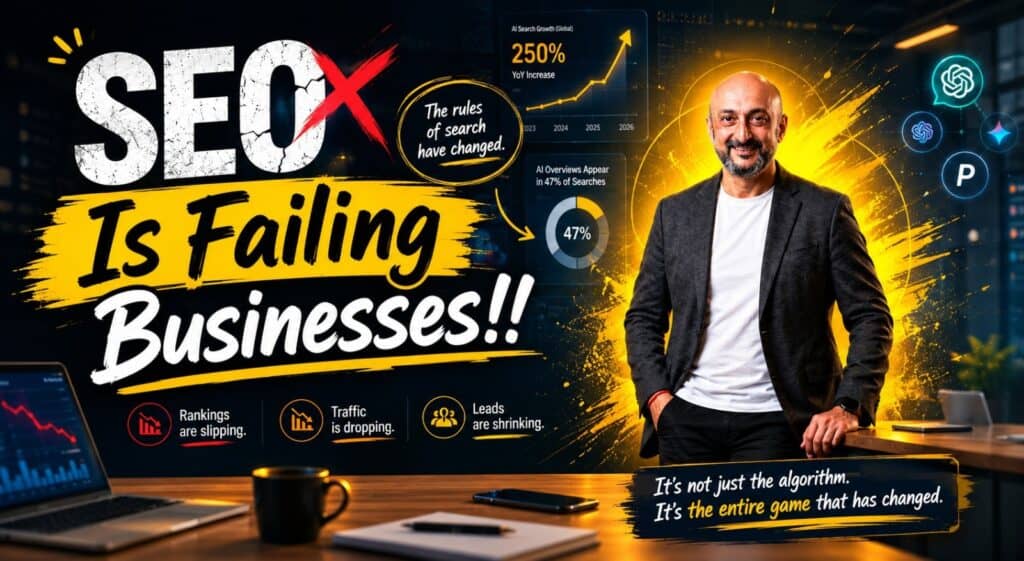
Why Businesses Need GEO Beyond SEO for Search Visibility
May 23, 2026 | Blog
Generative Engine Optimization (GEO) is the practice of increasing a brand’s visibility within AI-generated answers from platforms such as ChatGPT, Gemini, Perplexity and Google’s AI-powered search experiences. While SEO focuses on ranking webpages, GEO focuses on becoming a trusted source that AI systems reference when answering questions.
Search Has Changed More in the Last Two Years Than the Previous Ten
For nearly two decades, digital visibility followed a relatively simple path.
A potential customer searched on Google.
A business appeared in the results.
The user clicked a link.
The website did the selling.
That model is no longer the only path to discovery.
Today, millions of users ask questions directly to AI platforms before they ever visit a website.
They ask:
- What is the best CRM for a manufacturing company?
- Which digital marketing agency should a startup consider?
- How can I improve lead generation for my real estate business?
- What are the top SEO strategies for 2026?
Increasingly, the answer arrives before the click.
According to research from Statista, adoption of AI-powered search and conversational interfaces continues to accelerate globally as users seek faster, more contextual answers rather than traditional lists of links.
For businesses, this creates a new challenge.
Ranking well is no longer enough.
The question has become:
Will AI mention your brand when customers ask?
That is where GEO enters the conversation.
What Is GEO?
Generative Engine Optimization (GEO) refers to optimizing a company’s digital presence so AI-powered systems can identify, understand and confidently reference that business when generating answers.
Unlike traditional SEO, which focuses on improving rankings within search engine results pages, GEO focuses on increasing visibility within AI-generated responses.
A widely cited academic study by researchers from Princeton University and collaborators on Generative Engine Optimization found that content structure, authoritative references, statistical support and credibility signals can significantly influence how generative systems surface information.
In practical terms:
SEO helps people find your website.
GEO helps AI understand why your business deserves to be referenced.
The distinction may seem subtle.
Its business impact is not.
Why SEO Alone Is No Longer Enough
SEO remains one of the most valuable marketing investments available.
Organic search continues to drive high-intent traffic, qualified leads and long-term visibility.
But customer discovery is becoming increasingly fragmented.
Modern buyers move between:
- Google Search
- Google AI Overviews
- ChatGPT
- Gemini
- Perplexity
- YouTube
- Industry communities
- Podcasts
- News platforms
According to insights published by Google Search Central and consumer behaviour research from HubSpot Research, users increasingly expect immediate answers, contextual recommendations and frictionless information discovery.
The result is a shift from search visibility to answer visibility.
Many businesses continue investing heavily in SEO while overlooking how potential customers increasingly discover information through AI-assisted experiences.
That creates a gap.
Not between good and bad SEO.
But between being searchable and being referenced.
The GEO Gap Most Businesses Do Not Realize Exists
This is where many marketing teams become frustrated.
They publish content consistently.
They invest in SEO.
Their website loads quickly.
They maintain social media activity.
Yet they rarely appear in AI-generated recommendations.
The assumption is usually that AI search works like traditional search.
It doesn’t.
A company can rank reasonably well and still struggle to become part of AI-generated answers.
A brand can publish weekly blogs and still fail to establish the trust signals AI systems increasingly rely upon.
A business can generate traffic while remaining absent from conversational search experiences.
This is what we describe as the GEO Gap.
The difference between visibility on a search engine and visibility inside an answer engine.
As AI adoption grows, that gap is becoming increasingly important for businesses that depend on digital discovery.
Why Some Brands Consistently Appear in AI Answers
The uncomfortable truth is that there is no universal GEO checklist.
No plugin.
No shortcut.
No guaranteed formula.
AI systems evaluate a broad set of credibility and relevance signals across the web.
This means many businesses are unknowingly optimizing for yesterday’s search environment while customers increasingly rely on tomorrow’s discovery platforms.
The brands gaining visibility are often not the loudest.
They are the most consistently trusted.
They demonstrate expertise across multiple touchpoints.
They establish authority within their category.
They maintain a clear digital footprint that reinforces credibility.
Most importantly, they make it easier for AI systems to understand who they are, what they do and why they matter.
That is fundamentally different from traditional keyword-focused optimisation.
What This Means for Businesses in 2026
The shift toward AI-assisted discovery does not mean SEO is dead.
Far from it.
Strong SEO remains the foundation of digital visibility.
However, businesses now need a broader visibility strategy that considers how customers discover information across both search engines and answer engines.
That requires asking new questions:
- Is our expertise visible beyond our website?
- Does our content answer the questions buyers are asking?
- Are we building authority or simply publishing content?
- Would an AI system understand our category expertise?
- Are we positioned as a source or merely another search result?
These questions increasingly determine whether a business becomes part of the conversation.
Or remains invisible to it.
Why Businesses Are Turning to SEO + AEO Strategies
One of the clearest trends emerging in 2026 is the convergence of SEO and Answer Engine Optimization (AEO).
While SEO helps improve discoverability in traditional search results, AEO focuses on structuring content so it can be surfaced directly in AI-powered answers, featured responses and conversational search experiences.
The two disciplines are no longer separate conversations.
They are becoming part of the same visibility strategy.
At The Violet, we have seen growing interest from businesses looking to future-proof their digital presence by combining traditional search visibility with answer-engine readiness. Our dedicated SEO and AEO approach focuses on helping brands become discoverable not only in search engines but also across emerging AI-driven discovery environments.
Explore our SEO and AEO services here:
The Future Belongs to Brands That Become Sources
For years, businesses competed to rank.
Today they are beginning to compete to be referenced.
That shift changes everything.
Visibility is no longer measured solely by rankings.
It is increasingly measured by trust.
By authority.
By relevance.
By whether intelligent systems view your business as a credible source worth mentioning.
The companies that understand this transition early will build an advantage that extends far beyond search rankings.
Because in the emerging world of AI-powered discovery, the winners will not simply be the brands that publish more content.
They will be the brands trusted enough to become part of the answer.
Read More : Marketing Trends: Why Gurgaon’s Top D2C Brands are Prioritizing AEO and GEO
Frequently Asked Questions
What is Generative Engine Optimization (GEO)?
Generative Engine Optimization (GEO) is the practice of improving a brand’s visibility within AI-generated responses from platforms such as ChatGPT, Gemini, Perplexity and other answer engines.
Is GEO replacing SEO?
No. GEO complements SEO rather than replacing it. Businesses still need strong SEO foundations while adapting their content and authority strategy for AI-driven discovery.
What is the difference between SEO and GEO?
SEO focuses on improving rankings within search engine results pages. GEO focuses on increasing the likelihood that AI systems reference, summarize or recommend a brand when answering user questions.
Why are AI search platforms becoming important?
Consumers increasingly seek direct answers rather than navigating multiple websites. AI-powered search experiences reduce friction and provide contextual information faster, changing how users discover businesses and solutions.
Can a website rank well on Google but still be invisible in AI search?
Yes. Strong search rankings do not automatically guarantee visibility within AI-generated answers. Businesses increasingly need authority, credibility and answer-focused content strategies alongside traditional SEO.
How can businesses prepare for GEO?
Businesses should focus on strengthening their expertise, authority, content quality, digital presence and discoverability across multiple platforms. GEO is not a single tactic but part of a broader visibility strategy.
Why should businesses consider SEO and AEO together?
SEO helps customers find a business through search engines, while AEO improves visibility within answer engines and AI-powered search experiences. Together, they create a stronger long-term discoverability strategy.