

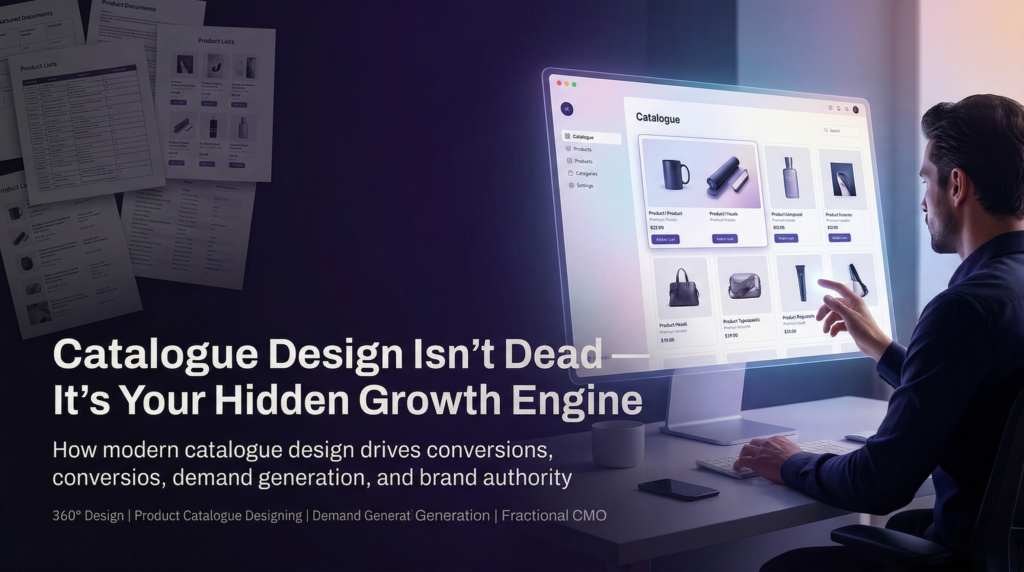
Why Catalogue Design Still Plays a Crucial Role in Modern Marketing Strategies
April 9, 2026 | Blog, Designing Services
Introduction: In a Digital World, Why Do Catalogues Still Matter?
In an era dominated by performance marketing, AI-driven ads, and real-time analytics, catalogues may seem like a legacy format. But the reality is quite the opposite.
Catalogues have evolved.
They are no longer just printed booklets, they are now strategic sales tools, digital assets, and brand storytelling frameworks.
At The Violet, we’ve seen businesses significantly improve conversions, sales conversations, and brand perception simply by upgrading how they present their offerings through structured catalogue design.
This blog explores why Catalogue Designing Services remain critical in modern marketing, and how businesses can leverage them effectively.
Quick Summary (For Fast Decision Makers)
- Catalogues act as structured sales narratives, not just design assets
- They improve conversion rates in both online and offline journeys
- Digital catalogues support SEO, AEO, and demand generation
- Strong catalogue design reduces dependency on sales explanations
- A 360 Degree Design Services approach integrates catalogues into full-funnel marketing
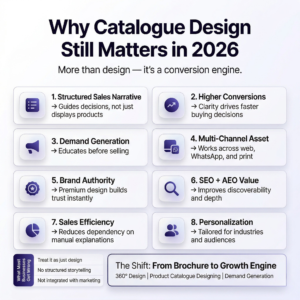
Why Catalogue Design Still Matters
-
Catalogues Are Structured Sales Engines
Unlike ads or social posts, catalogues provide a complete, controlled narrative.
Why This Matters:
- Ads capture attention
- Websites provide exploration
- Catalogues drive decision-making
The Advantage:
A well-designed catalogue:
- Presents products/services logically
- Builds trust through structured information
- Guides users toward action
According to McKinsey & Company, structured customer journeys significantly improve conversion outcomes compared to fragmented touchpoints.
The Insight:
Catalogues reduce friction by answering:
- What is the product?
- Why should I trust it?
- What should I choose?
-
Product Catalogue Designing Enhances Conversion Rates
Many businesses lose potential customers because of information overload or poor presentation.
The Problem:
- Unorganized product listings
- Inconsistent branding
- Lack of clarity
The Impact:
- Lower engagement
- Reduced trust
- Missed conversions
The Fix:
Product Catalogue Designing focuses on:
- Clear categorization
- Visual hierarchy
- Easy scanning
Industry Backing:
Research from HubSpot highlights that users prefer structured content formats that simplify decision-making.
-
Catalogues Bridge Online and Offline Marketing
Modern marketing is no longer siloed. Customers interact across:
- Websites
- Social media
- Physical meetings
Where Catalogues Fit:
Catalogues act as a universal asset that works across all channels:
- PDF for WhatsApp sharing
- Interactive digital catalogues for websites
- Printed catalogues for in-person sales
The Benefit:
Consistency across channels builds:
- Brand credibility
- Customer trust
- Faster decision-making
-
Catalogues Strengthen Demand Generation
Demand generation is about creating interest before conversion.
The Role of Catalogues:
Catalogues support demand generation by:
- Educating customers
- Showcasing expertise
- Highlighting product depth
The Insight:
According to Boston Consulting Group, content-led engagement significantly influences purchase decisions.
The Application:
Instead of just selling, catalogues can:
- Tell stories
- Highlight use cases
- Demonstrate value
-
Catalogue Design Reduces Sales Dependency
A strong catalogue acts as a silent salesperson.
Without a Catalogue:
- Sales teams repeat explanations
- Messaging varies
- Time-to-conversion increases
With a Catalogue:
- Information is standardized
- Communication becomes consistent
- Sales cycles shorten
The Result:
Better efficiency + higher conversions
-
Catalogues Improve Brand Perception
Your catalogue is often your first detailed impression.
The Problem:
Poor design signals:
- Low quality
- Lack of professionalism
- Weak brand positioning
The Opportunity:
Premium catalogue design communicates:
- Authority
- Trust
- Attention to detail
Industry Insight:
Bain & Company emphasizes that consistent brand experience directly impacts customer loyalty.
-
Digital Catalogues Support SEO and AEO
Modern catalogues are not just visual, they are also search assets.
How:
- Indexed PDFs
- Embedded web catalogues
- Structured product content
The Benefit:
Catalogues help:
- Capture long-tail search queries
- Improve content depth
- Enhance LLM discoverability
The Strategy:
Integrate catalogues with:
- SEO content
- Blog ecosystems
- Product pages
-
Catalogues Enable Better Personalization
With digital tools, catalogues can now be:
- Customized by industry
- Tailored to audience segments
- Adapted for specific campaigns
Example:
- Real estate → project-specific catalogues
- SaaS → feature-based catalogues
- Manufacturing → product-line catalogues
The Impact:
Personalization increases:
- Relevance
- Engagement
- Conversion rates
-
Catalogue Design as Part of 360 Degree Design Services
Catalogue design should not exist in isolation.
The Problem:
Businesses treat it as a one-time creative task.
The Reality:
It should be part of 360 Degree Design Services, integrating:
- Branding
- Website design
- Social media visuals
- Sales collateral
The Advantage:
Consistency across all touchpoints leads to:
- Stronger brand recall
- Higher trust
- Better marketing performance
-
The Strategic Role of a Fractional CMO
Most businesses struggle not because they lack design, but because they lack strategy.
The Gap:
- Design teams focus on visuals
- Marketing teams focus on campaigns
- No one aligns everything
The Solution:
A Fractional CMO Gurgaon approach ensures:
- Catalogue design aligns with business goals
- Messaging is consistent across channels
- Marketing assets work together
Insight:
EY highlights that strategic marketing leadership drives better ROI across initiatives.
How The Violet Approaches Catalogue Design
At The Violet, catalogue design is treated as a growth asset, not just a creative output.
Our Approach:
- Strategy-Led Design
We start with:
- Audience understanding
- Business goals
- Product positioning
- Structured Content Flow
Every catalogue is designed to:
- Educate
- Engage
- Convert
- Integration with Marketing Ecosystem
We ensure catalogues align with:
- SEO
- Paid campaigns
- Social media
- Premium Visual Execution
High-end design that reflects:
- Brand authority
- Professionalism
- Trust
- Scalable Formats
Catalogues built for:
- Digital sharing
- Interactive experiences
Conclusion: Catalogues Are Not Old, They’re Underutilized
The belief that catalogues are outdated is one of the biggest misconceptions in modern marketing.
In reality, they are:
- Conversion tools
- Brand builders
- Demand generators
When designed strategically, catalogues can:
- Improve marketing efficiency
- Strengthen brand positioning
- Drive measurable business outcomes
Transform Your Catalogue Into a Growth Engine
If your current catalogue is:
- Just a list of products
- Poorly designed
- Not integrated with your marketing
It’s time to rethink your approach.
Book a free consultation with The Violet:
https://calendly.com/praveen-theviolet/30min
Let’s turn your catalogue into a high-performing marketing asset.
FAQs
Why is catalogue design important in modern marketing?
Catalogue design helps present products in a structured, engaging way that improves customer understanding and conversion rates.
Are catalogues still relevant in digital marketing?
Yes, digital catalogues are widely used across websites, WhatsApp, and email, making them highly relevant.
What is product catalogue designing?
It involves organizing and presenting product information visually and strategically to improve user experience and sales.
How does catalogue design impact sales?
A well-designed catalogue reduces confusion, builds trust, and speeds up decision-making, leading to higher conversions.
What are 360 degree design services?
These are integrated design solutions that ensure consistency across all brand touchpoints, including catalogues, websites, and marketing materials.