

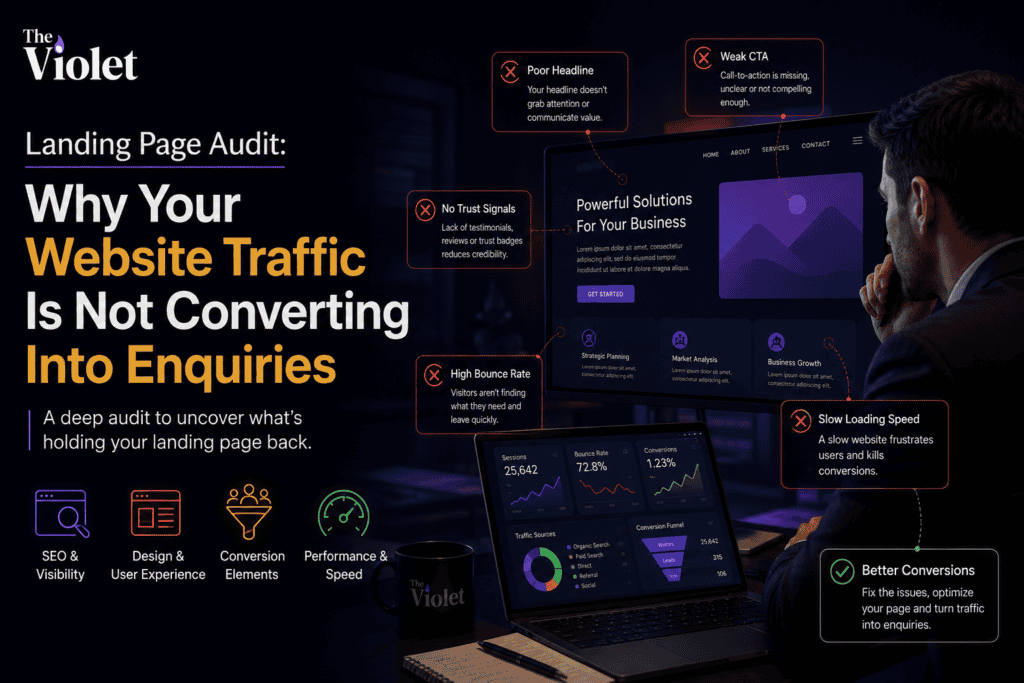
Landing Page Audit: Why Your Website Traffic Is Not Converting Into Enquiries
July 12, 2026 | Blog, Website Development
Getting traffic is not the same as getting enquiries.
Many businesses invest in Google Ads, Meta Ads, LinkedIn Ads, SEO and social media, but still struggle with one uncomfortable problem.
People are visiting the website.
Campaigns are getting clicks.
Analytics is showing traffic.
The business is still not getting enough qualified enquiries.
When this happens, most teams blame the ad campaign, the platform or the audience.
Sometimes that is true.
But very often, the real problem is the landing page.
A landing page is where interest becomes action. If the page does not build trust, answer the visitor’s questions and guide them toward the next step, even good traffic will fail to convert.
This blog explains why your website traffic may not be converting into enquiries, what a landing page audit should check and how businesses can fix conversion gaps before spending more on ads.
Why Landing Pages Matter More Than Most Businesses Think
Your landing page is not just a web page.
It is a sales conversation.
When a visitor lands on your page, they are silently asking:
Am I in the right place?
Does this business understand my problem?
Can I trust them?
Is the offer relevant to me?
What should I do next?
Why should I choose this company over others?
If the page does not answer these questions quickly, the visitor leaves.
This is why businesses running Performance Marketing should never treat landing pages as an afterthought. Ads can bring traffic, but the landing page converts that traffic into enquiries.
A good campaign with a weak landing page will underperform.
A strong landing page can improve campaign results without increasing media spend.
The Common Problem: Traffic Is Coming, Enquiries Are Not
This is one of the most common digital growth problems.
A business may have:
- Website visitors
- Ad clicks
- Social media traffic
- SEO impressions
- Blog readers
- Landing page visits
But still not enough:
- Form submissions
- Calls
- Demo requests
- Consultation bookings
- Product enquiries
- Sales-qualified leads
This gap usually means the website is attracting attention but not creating action.
The problem may not be visibility.
The problem may be conversion.
That is why a landing page audit is important. It helps identify where the page is leaking potential enquiries.
What Is A Landing Page Audit?
A landing page audit is a detailed review of a page to understand why visitors are not taking action.
It checks the full conversion journey, including:
- Page headline
- Messaging clarity
- Offer relevance
- CTA strength
- Page structure
- Visual hierarchy
- Mobile experience
- Load speed
- Trust signals
- Proof points
- Form design
- Tracking setup
- Content flow
- User friction
- Lead quality
The goal is not only to make the page look better.
The goal is to make the page work better.
A landing page audit helps answer one key question:
Why are visitors not becoming enquiries?
Reason 1: The Headline Does Not Match Visitor Intent
The headline is the first thing most visitors notice.
If it is vague, generic or disconnected from the ad, the visitor may leave within seconds.
For example, if someone clicks an ad for “Google Ads audit” and lands on a page that says “We Are A Digital Marketing Agency,” the message is too broad.
The visitor expected a specific solution.
The page gave them a generic introduction.
A strong landing page headline should clearly communicate:
- What the service is
- Who it is for
- What problem it solves
- Why the visitor should continue reading
Instead of saying:
Grow Your Business With Us
A stronger headline may say:
Find Out Why Your Google Ads Are Getting Leads But Not Customers
This speaks directly to the visitor’s problem.
The more specific the headline, the stronger the conversion intent.
Reason 2: The Page Talks About The Company Before The Customer
Many landing pages start with:
“We are a leading agency.”
“We offer end-to-end solutions.”
“We have years of experience.”
“We provide complete services.”
The problem is that the visitor does not care yet.
They first want to know whether you understand their problem.
A good landing page should begin with the customer’s pain point, not the company’s profile.
For example:
Your traffic is increasing, but enquiries are not.
Your ads are getting clicks, but the form is not converting.
Your website looks good, but visitors are leaving.
Your sales team says the leads are not qualified.
This kind of opening makes the visitor feel understood.
Once the problem is clear, the company can explain how it helps.
The order matters.
Problem first.
Solution second.
Proof third.
CTA fourth.
Reason 3: The Offer Is Not Clear
A landing page must make the next step obvious.
If the offer is unclear, visitors hesitate.
A weak CTA says:
Submit
Contact Us
Learn More
A stronger CTA says:
Book a Landing Page Audit
Get Your Website Reviewed
Request a Conversion Review
Speak To A Growth Strategist
The CTA should tell the visitor what they are getting.
For a business that wants more enquiries, the CTA should not feel like a generic contact button. It should feel like a useful next step.
For example, The Violet’s Website Development work should not only be positioned as building websites. It should be positioned as building conversion-ready digital assets that help businesses turn traffic into enquiries.
The offer should match the visitor’s intent.
Reason 4: There Is No Strong Reason To Trust The Business
Traffic does not convert without trust.
A visitor may like the service, but if the page does not prove credibility, they may still avoid taking action.
Trust signals can include:
- Case studies
- Client logos
- Testimonials
- Industry experience
- Founder credibility
- Before and after examples
- Process explanation
- Results snapshots
- Certifications
- Media mentions
- Clear contact details
- Strong service pages
- Helpful blogs
For example, instead of only saying “We help businesses generate leads,” a landing page can link to a relevant case study such as how The Violet structured a high-intent real estate funnel or rebuilt a demand engine for an automotive brand.
Proof reduces hesitation.
A landing page without proof asks the visitor to believe.
A landing page with proof helps the visitor decide.
Reason 5: The Page Has Too Many Messages
Many landing pages try to say everything.
They talk about:
- SEO
- Google Ads
- Social media
- Branding
- Website development
- Design
- Automation
- Content
- Lead generation
- Strategy
The result is confusion.
A landing page should usually focus on one primary conversion goal.
If the page is for Google Ads leads, the message should focus on Google Ads and lead quality.
If the page is for website development, the message should focus on website performance and enquiries.
If the page is for SEO, the message should focus on visibility and organic growth.
If the page is for a Fractional CMO service, the message should focus on leadership, strategy and execution alignment.
The Violet already has different service areas such as SEO & AEO, Fractional CMO, Performance Marketing, Design Services and Website Development. Landing pages should use this same clarity.
One page should not try to do everything.
It should do one job well.
Reason 6: The CTA Is Hidden Or Weak
A visitor should never have to search for the next step.
Many landing pages have CTA issues such as:
- CTA appears only at the bottom
- Button text is vague
- CTA color does not stand out
- Too many different CTAs
- No CTA after important sections
- Form is difficult to find
- Mobile CTA is not visible enough
- CTA does not match the offer
A good page should include CTAs at natural decision points.
For example:
After explaining the problem.
After showing the service.
After presenting proof.
After answering objections.
At the end of the page.
The CTA should be clear and action-led.
For this blog topic, a strong CTA would be:
Book a Landing Page Audit
or
Get Your Website Conversion Reviewed
The goal is to make the next step easy.
Reason 7: The Page Looks Good But Does Not Sell
A beautiful page is not always a high-converting page.
Design matters, but conversion design matters more.
A landing page should use design to guide the user.
That means:
- Clear headline hierarchy
- Short sections
- Strong visual contrast
- Easy scanning
- Clear CTA placement
- Trust signals placed near decision points
- Mobile-friendly structure
- Fast load time
- Clean forms
- Minimal distractions
A page can look premium and still fail if the message is unclear.
This is where Design Services and conversion strategy should work together.
The question is not only:
Does the page look good?
The better question is:
Does the page make the visitor take the next step?
Reason 8: The Form Creates Friction
Forms are one of the biggest conversion points on a landing page.
If the form feels too long, too vague or too intrusive, visitors may drop off.
Common form problems include:
- Too many fields
- No clear form headline
- Asking for unnecessary information
- Poor mobile usability
- No confirmation message
- No expectation-setting
- Generic submit button
- No reason to complete the form
At the same time, forms should not be too basic if the business needs qualified leads.
A form that only asks for name and phone number may increase volume but reduce quality.
The right form depends on the goal.
For high-volume campaigns, keep the form simple.
For B2B and high-ticket services, add qualifying fields such as:
- Business name
- Website
- Service required
- Current challenge
- Preferred contact time
This helps improve lead quality and sales follow-up.
Reason 9: The Page Does Not Address Objections
Visitors usually have doubts before they enquire.
They may wonder:
Will this company understand my business?
Will this be expensive?
Will I get practical recommendations?
Have they worked with similar businesses?
Will they only run ads or fix the full funnel?
Will this work for my industry?
What happens after I fill the form?
A good landing page should answer these doubts before the visitor leaves.
This can be done through:
- FAQs
- Process sections
- Case studies
- Service breakdowns
- Clear expectations
- Proof points
- Consultation details
For example, The Violet’s blog on choosing a digital marketing agency in Gurgaon already explains how businesses should evaluate strategy, reporting, team structure and outcomes before signing with an agency.
A landing page should follow the same principle.
Answer the questions that stop people from enquiring.
Reason 10: There Is No Sales Alignment
A landing page can generate enquiries, but the sales process must convert them.
If sales follow-up is slow, unclear or inconsistent, even a good landing page can look like it is underperforming.
Common sales alignment issues include:
- Leads not assigned quickly
- No call-back process
- No CRM update
- No lead quality feedback
- No follow-up sequence
- No WhatsApp or email follow-up
- No lead source tracking
- No meeting booking process
Marketing and sales should not work separately.
The landing page should create a lead that the sales team can act on.
For example, if the page promises a “Landing Page Audit,” the sales team should know exactly what to ask, what to review and how to position the next conversation.
Otherwise, the promise breaks after the lead is captured.
This is also why businesses often need strategic support beyond execution. A Fractional CMO approach can help align campaigns, landing pages, sales feedback and business goals into one growth system.
Reason 11: The Page Is Not Built For Mobile
Most users will not patiently browse a poorly designed mobile page.
Mobile landing page issues include:
- Slow loading
- Small text
- Crowded sections
- Buttons too low on the page
- Forms difficult to fill
- Images taking too much space
- Poor spacing
- Sticky elements blocking content
- Hard-to-read proof sections
A desktop page may look impressive, but if the mobile version is difficult to use, conversions will suffer.
A landing page audit should always review mobile experience separately.
The question is simple:
Can a visitor understand the offer and enquire within a few seconds on mobile?
If not, the page needs work.
Reason 12: The Page Speed Is Hurting Conversion
Speed affects user experience.
A slow landing page creates friction before the visitor even reads the headline.
This is especially important for paid campaigns, where every click has a cost.
If the page takes too long to load, the business loses money before the sales conversation even begins.
A landing page audit should check:
- Page load time
- Image size
- Scripts
- Mobile performance
- Hosting issues
- Unused plugins
- Heavy animations
- Tracking code overload
- Core Web Vitals
- Form load behavior
A fast page is not a technical luxury.
It is a conversion requirement.
Reason 13: The Page Is Not Connected To SEO, AEO Or GEO
Landing pages are often created only for ads.
That is a missed opportunity.
A strong landing page can also support organic visibility if it is structured properly.
This includes:
- Search-friendly headings
- Clear service intent
- FAQs
- Schema-ready content
- Internal links
- Helpful answers
- Location relevance
- Topic authority
- Strong page structure
As search shifts toward AI-generated answers and zero-click discovery, landing pages should also support answer-friendly visibility.
The Violet’s blog on AEO vs SEO explains why businesses now need to think beyond traditional rankings. The blog on GEO beyond SEO also explains why brands need visibility across AI-led search experiences.
This matters because a good landing page should not only convert paid traffic.
It should also strengthen the brand’s discoverability.
What A Landing Page Audit Should Check
A proper landing page audit should review the full journey.
- Traffic Source Alignment
Does the landing page match the ad, keyword, social post or email that brought the visitor?
If the source and page do not match, conversions drop.
- Headline Clarity
Does the headline clearly explain the problem, solution or outcome?
A vague headline weakens the first impression.
- Offer Strength
Is the offer clear enough for the visitor to act?
A generic “contact us” may not be enough.
- CTA Placement
Are CTAs visible at the right moments?
A page should guide action naturally.
- Trust Signals
Does the page show proof, testimonials, results, clients or case studies?
Without trust, visitors hesitate.
- Form Quality
Is the form easy to complete and strong enough to qualify leads?
Forms should balance volume and quality.
- Mobile Experience
Does the page work smoothly on mobile?
Mobile conversion should never be assumed.
- Page Speed
Does the page load quickly enough for paid and organic traffic?
Slow pages waste traffic.
- Content Flow
Does the page move from problem to solution to proof to action?
Random sections reduce conversion clarity.
- Tracking
Are form submissions, calls, button clicks and lead sources being tracked properly?
Without tracking, optimization becomes guesswork.
Landing Page Audit vs Website Audit
A landing page audit and website audit are related, but they are not the same.
A website audit looks at the broader site.
It may include:
- Technical SEO
- Site structure
- Page speed
- Navigation
- Content quality
- Internal linking
- UX
- Conversion paths
- Service pages
A landing page audit focuses more specifically on one conversion page.
It checks whether a specific page is helping visitors take action.
For example, The Violet’s Website Development service can help with broader website strategy, while a landing page audit focuses on the conversion performance of a campaign page, service page or lead-generation page.
Both matter.
But if you are running paid ads, landing page performance becomes urgent.
When Should A Business Do A Landing Page Audit?
You should do a landing page audit if:
- Website traffic is increasing but enquiries are not
- Google Ads are getting clicks but not conversions
- Meta Ads are generating poor-quality leads
- LinkedIn Ads are expensive but not producing pipeline
- Visitors are dropping off quickly
- Form submissions are low
- Sales says the leads are not qualified
- Mobile conversion is weak
- Campaign CPL is rising
- Website design looks good but business results are weak
- You are planning to increase ad budget
- You are redesigning your website
Before spending more on traffic, fix the page that receives the traffic.
How Landing Pages Affect Performance Marketing
Performance marketing is not only about campaign setup.
It is about the full funnel.
The funnel includes:
- Targeting
- Creative
- Ad copy
- Landing page
- Form
- Tracking
- Follow-up
- Sales feedback
- Optimization
The Violet’s Performance Marketing approach focuses on full-funnel growth because ads do not work in isolation.
A campaign can bring the right person to the page.
But the page has to convince them to act.
This is why landing page audits are essential before scaling campaigns.
How Landing Pages Affect B2B Lead Generation
B2B landing pages need a different approach.
A B2B buyer is usually not impulsive.
They compare options, check credibility, review expertise and look for relevance.
For B2B landing pages, the page should include:
- Clear industry fit
- Business problem
- Service clarity
- Process explanation
- Proof
- Case studies
- Strong CTA
- Sales-ready form
- Trust-building content
- Helpful FAQs
If your business runs LinkedIn Ads or ABM campaigns, the landing page must feel relevant to decision-makers.
The Violet’s blog on LinkedIn Ads for B2B Lead Generation in India explains why B2B targeting and intent matter. The same thinking should apply to landing pages.
A B2B landing page should not chase everyone.
It should qualify the right people.
How To Improve A Landing Page After An Audit
Once the audit identifies the gaps, improvements can be made in phases.
Step 1: Rewrite The Headline
Make it specific to the audience and problem.
Step 2: Clarify The Offer
Tell visitors exactly what they get after taking action.
Step 3: Improve The CTA
Use clear action language instead of generic button text.
Step 4: Add Proof
Include case studies, testimonials, client experience or relevant examples.
Step 5: Reduce Friction
Make the page easier to read, scan and act on.
Step 6: Improve Mobile Layout
Prioritize mobile readability, CTA visibility and form usability.
Step 7: Improve Page Speed
Compress images, reduce unnecessary scripts and simplify heavy elements.
Step 8: Connect Tracking
Track form submissions, calls, button clicks and lead quality.
Step 9: Align Sales Follow-Up
Make sure the sales team knows what the landing page promised.
Step 10: Test And Improve
Landing pages should be improved continuously based on traffic, user behavior and lead quality.
Common Landing Page Mistakes To Avoid
Mistake 1: Sending Paid Traffic To The Homepage
Your homepage is usually built for general discovery.
A paid campaign needs a focused landing page.
Mistake 2: Writing For Everyone
A landing page that speaks to everyone usually converts no one.
Be specific.
Mistake 3: Using A Weak CTA
“Submit” is not a conversion strategy.
Use action-led CTA language.
Mistake 4: Ignoring Proof
Claims without proof create hesitation.
Add trust signals.
Mistake 5: Making The Form Too Difficult
A form should qualify leads without creating unnecessary friction.
Mistake 6: Not Tracking Lead Quality
A page may generate leads, but the business must know whether those leads are useful.
Mistake 7: Designing Before Defining Strategy
Design should follow the conversion strategy.
A good-looking page without a clear offer will still underperform.
How The Violet Helps With Landing Page Audits
The Violet helps businesses review landing pages from a full-funnel growth perspective.
The goal is not just to redesign the page.
The goal is to understand why traffic is not converting into qualified enquiries.
The Violet can help with:
- Landing page audit
- Website conversion review
- Messaging audit
- CTA improvement
- Form optimization
- Mobile UX review
- Page speed review
- Campaign-to-page alignment
- Lead quality analysis
- Tracking recommendations
- Website redesign strategy
- Performance marketing funnel review
This connects directly with The Violet’s broader work across Performance Marketing, Website Development, SEO & AEO, Design Services and Fractional CMO.
A landing page should not be judged only by how it looks.
It should be judged by how well it converts the right traffic into the right enquiry.
Final Thoughts
If your website traffic is not converting into enquiries, do not rush to increase the ad budget.
First, audit the landing page.
Check the headline, offer, CTA, proof, form, mobile experience, page speed, tracking and sales follow-up.
The issue may not be that people are not interested.
The issue may be that the page is not giving them enough reason to act.
Traffic creates opportunity.
Landing pages convert opportunity.
And when your landing page works better, every marketing channel becomes more valuable.
Want To Know Why Your Website Traffic Is Not Converting?
If your website is getting traffic but not enough enquiries, The Violet can help you identify where the conversion journey is breaking.
We review your landing page, messaging, CTA, form, mobile experience, campaign alignment and lead quality to find what needs to change.
Before you spend more on ads, fix the page where your traffic is landing.
Book a Landing Page Audit With The Violet
FAQs
What is a landing page audit?
A landing page audit is a detailed review of a landing page to identify why visitors are not converting into enquiries. It checks messaging, CTA, layout, mobile experience, speed, forms, trust signals and tracking.
Why is my website getting traffic but no enquiries?
Your website may be getting traffic but no enquiries because the page does not match visitor intent, the offer is unclear, the CTA is weak, the page lacks proof, the form creates friction or the mobile experience is poor.
Is a landing page different from a website page?
Yes. A website page may provide general information, while a landing page is usually built for a specific campaign, audience or conversion goal.
Should I send Google Ads traffic to my homepage?
Usually, no. A homepage is often too broad. Google Ads traffic should usually go to a focused landing page that matches the keyword, ad message and offer.
What should a landing page include?
A strong landing page should include a clear headline, relevant offer, problem statement, service explanation, proof, CTA, form, FAQs and trust signals.
How does landing page speed affect conversions?
Slow landing pages create friction and increase drop-offs. Faster pages improve user experience and help more visitors reach the CTA or form.
Can landing pages improve lead quality?
Yes. A well-structured landing page can improve lead quality by using clearer messaging, stronger qualification, better forms and more relevant offers.
How often should landing pages be reviewed?
Landing pages should be reviewed whenever campaigns are underperforming, traffic increases without enquiries, lead quality drops or the business changes its offer, audience or positioning.
Can The Violet help improve landing page conversions?
Yes. The Violet can audit your landing page, review the full conversion journey and recommend improvements across messaging, design, CTA, form, tracking and campaign alignment.